Honed or polished: choosing a marble finish you can live with
The same slab behaves differently depending on how it was finished. A practical comparison for anyone specifying a table, island or vanity they intend to actually use.
Two slabs can be cut from the same block, sold under the same name, and behave quite differently in your home. The variable is the finish, and it is decided before the stone ever reaches you.
If you are specifying a dining table, an island or a vanity, this is one of the few choices that will shape your daily experience of the piece for years. It deserves more than a showroom glance.
What is the difference between honed and polished marble?
Polished marble has been ground and buffed through progressively finer abrasives until the surface reflects. Honed marble is stopped before that final stage, leaving a smooth but matte surface.
It is the same stone. The difference is entirely how far the finishing process was taken.
Polishing does two things at once. It creates the reflective quality people associate with marble, and it compacts the surface slightly, closing some of the pore structure. Honing leaves the surface flatter in optical terms and marginally more open.
Neither is a coating. Neither is a treatment applied to the stone. Both are simply degrees of the same mechanical process.
How do they behave differently in use?
| Polished | Honed | |
|---|---|---|
| Appearance | Reflective; colour and veining appear deeper | Matte; colour reads softer and lighter |
| Etching | Still occurs, and is highly visible against the shine | Still occurs, but far less conspicuous |
| Absorption | Slightly more resistant | Slightly more absorbent |
| Fingerprints and smears | Show readily | Show far less |
| Everyday wear | Accumulates visibly as dull patches | Blends into the surface |
The single most useful line in that table is the etching row, because it is the one that decides how a piece ages in a household.
Etching dulls the stone. On a polished surface, a dull patch sits against a mirror, and the contrast is what makes it obvious. On honed stone, the surface is already matte — so the etch has far less to contrast against. The chemistry is identical. The visibility is not.
So is honed simply the safer choice?
Not automatically, and this is where a general rule stops being useful.
Honed surfaces are marginally more open, so they tend to absorb a spill faster. A honed table in a household that cooks with oil and turmeric may show marks a polished one would have given you time to catch. Honed finishes also read very differently in a room: colour appears lighter, veining is quieter, and the stone can look chalky under certain lighting when it is dry.
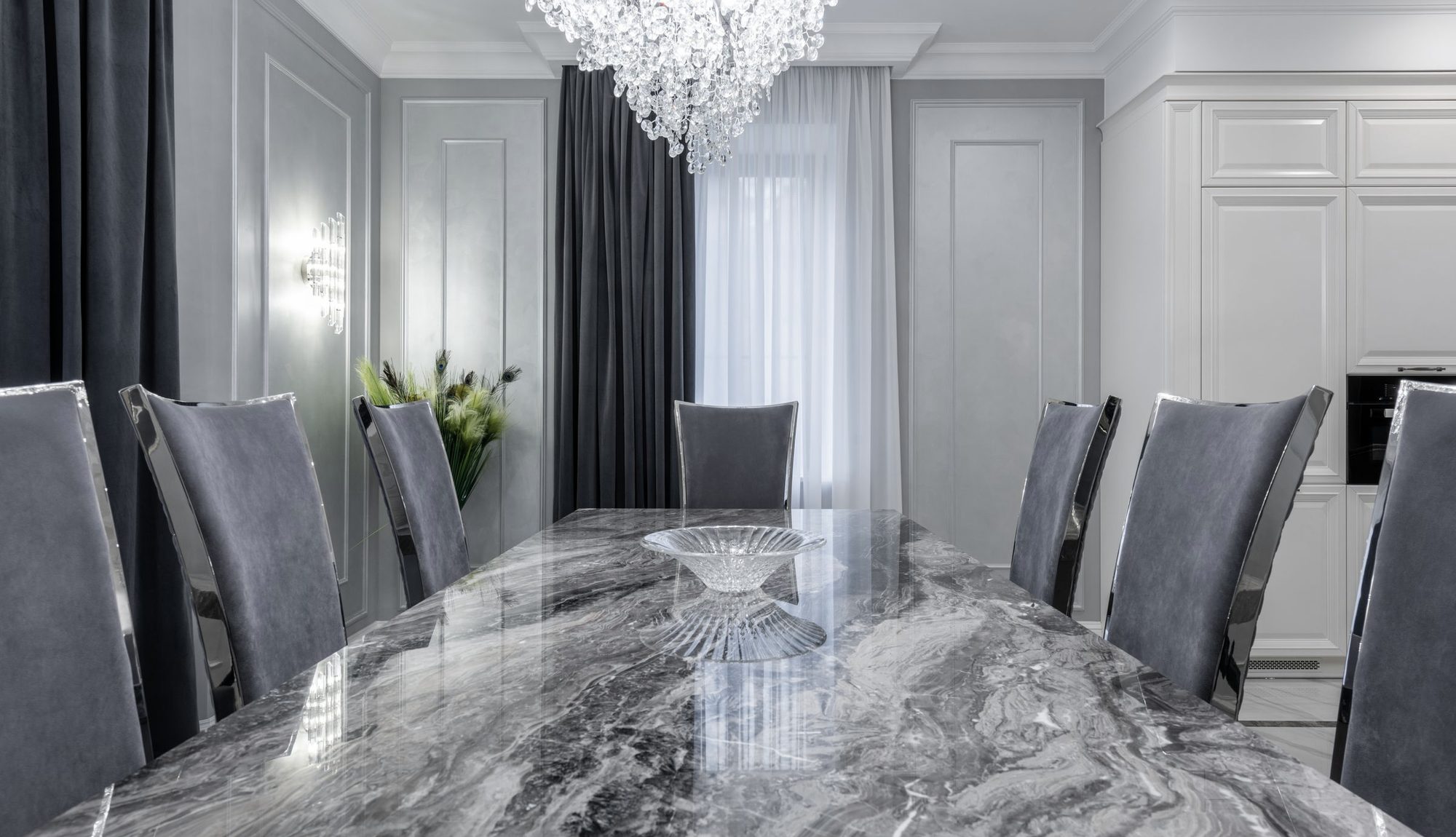
There is also the matter of what you want from the material. A polished dark marble in an entrance, catching lamplight, is doing something a honed finish cannot do. If a console is admired rather than worked on, the case for polish is straightforward.
The honest framing is not which finish is better. It is: what is this piece for, and how visible are you willing to let ordinary use become?
A way to decide
Work through the piece rather than the finish.
How is it actually used? Not how it is imagined. A dining table where a family eats every evening, with children and citrus and hot dishes, is a different object from one used twice a month for guests.
Who uses it, and how forgiving is the household? Some people read a softened, marked surface as character. Others find a single dull ring genuinely upsetting. Both are legitimate; they lead to different specifications.
What is the light doing? Raking light from a window or a low pendant is unforgiving on polished stone and reveals etching that overhead light hides entirely. Look at the room at the hour it is most used.
What will the edge profile do? A shaped edge is finished the same way as the top, and on a polished piece the edge often takes the heaviest contact — hips, chairs, cleaning cloths.
What this means for protection
Finish changes the protection conversation more than most people expect.
A protective film reads differently on matte and reflective surfaces. Compatibility depends on the finish as much as the material, and the visual result on a honed surface is a different question from the visual result on a polished one. Sealing performs differently too, because the two surfaces present different pore structures.
This is precisely why we establish material, sealant, finish and use before recommending anything. "Marble" is not a specification. Polished Carrara sealed two years ago in a dining room that hosts eight people weekly, and honed Indian green on a guest vanity, are different problems with different answers — and sometimes the answer is aftercare guidance rather than a product.
If the stone is already in the house
You are not stuck with the finish you have.
A polished surface that has accumulated etching across its whole area can be honed in place. Many people find this preferable to chasing individual repairs, because it resolves the contrast problem rather than fighting it — the marks stop standing out because there is no longer a mirror for them to interrupt.
Going the other way, from honed to polished, is also possible but asks more of the stone and is a less common request.
Either way it is skilled work carried out on site, and it is worth understanding what your surface currently is before deciding what to do with it.
If you are choosing a finish now, tell us the object, the stone if you know it, the room and how it will be used. If the piece is already in place, the same details still apply — and a photograph in raking light usually says more than a description.
Common questions
Does honed marble stain more easily than polished?
Generally yes. Polishing closes the surface as it compacts it, so a polished slab tends to resist absorption slightly better. The difference is real but modest, and prompt spill handling matters more than the finish either way.
Does honed marble hide etching?
It hides it far better. Etching dulls the surface, so on an already-matte finish there is much less contrast to notice. The etch still exists; it simply reads as part of the surface rather than as a mark on it.
Can a polished marble table be changed to honed?
Yes. Honing an existing polished surface is a refinishing job carried out in place by a stone specialist. It is sometimes the most sensible answer for a polished table that has accumulated etching across its whole surface.
Which finish is better for a kitchen island?
For an island in genuine daily use, honed is usually the more forgiving choice, because the marks a working kitchen produces are less visible on it. Polished tends to suit pieces that are looked at more than they are worked on.
WHERE THIS GETS SPECIFIC
Every recommendation
follows an assessment.
Tell us the object, the material and finish if you know them, and how the space is used. That is enough to begin.
Tell us about your spaceKEEP READING